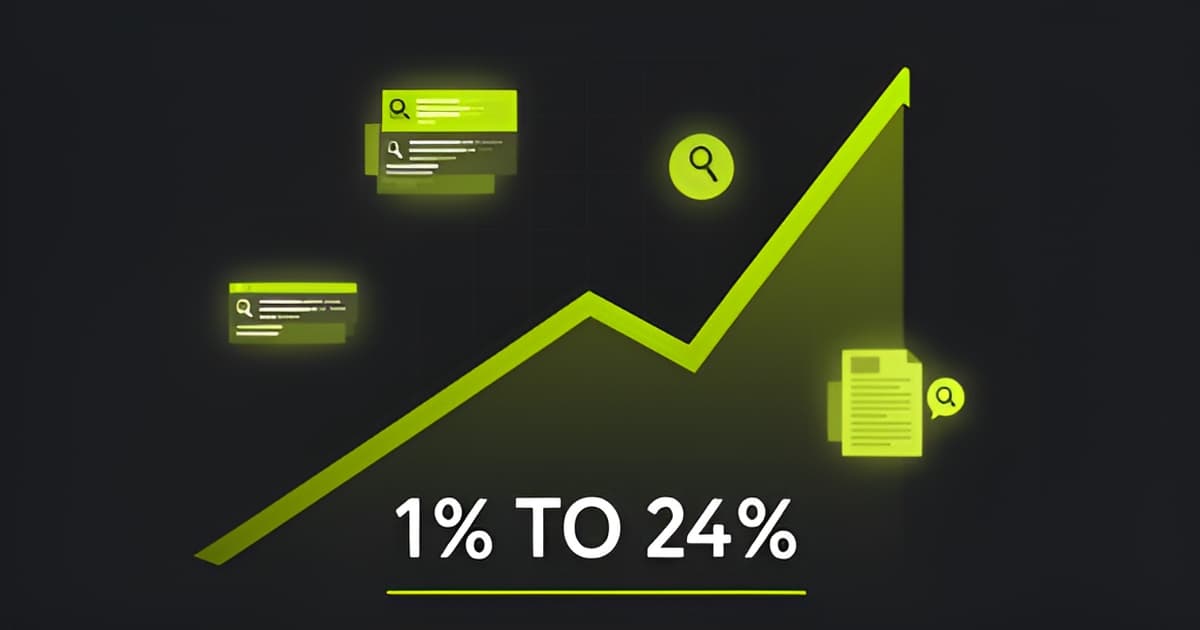
When a marketing campaign moves its AI citation rate from 1.3% to 24% in four months, the tempting reaction is to assume some secret technique was involved. There wasn't. The campaign, run by Brandi AI with Gabriel Marketing Group and now a finalist in PR Daily's AI Search & Answer Engine Visibility category, relied on tactics most business owners already understand: better pages, useful content written by humans, and coverage in places AI systems already read. The difference was measurement and discipline. That combination matters for small businesses, because it suggests AI visibility is less about gaming a black box and more about making your business easy for these systems to find, verify, and quote. Roughly 26% of adult internet users worldwide now use AI tools to research brands and purchases, according to the Digital 2027 Global Overview Report. If a quarter of your potential customers are asking ChatGPT or Google's AI Overviews who to hire, being absent from those answers is a revenue problem.
Key points
- A B2B PR campaign tracked across seven AI platforms saw its citation rate climb from 1.3% to 24% over 120 days, with Google AI Overviews citations rising from 0.7% to 44%, based on analysis of 55,671 AI answers.
- The tactics were unglamorous: optimized website pages, a 10-part human-written blog series mapped to the buyer journey, and earned media.
- Generative engines pull answers from news coverage, community threads, reviews, and expert content, so consistent business facts across channels matter more than any single trick.
- Roughly 26% of adult internet users worldwide now use AI tools to research brands and purchases, which turns AI visibility into a commercial issue for local firms.
- Results like these are directional, not guarantees; no one can promise a specific citation rate or inclusion in any AI answer.
The reported results are worth reading carefully because they show what measurement looks like when it's done honestly. Over a 120-day window, the team analyzed 55,671 AI-generated answers across seven platforms. Overall citation rate for the brand rose from 1.3% to 24%. On Google AI Overviews specifically, citations went from 0.7% to 44%. The campaign also reached the #2 position in AI visibility for its tracked B2B tech queries and attributed three qualified leads to AI-driven discovery. Three leads sounds modest until you remember where they came from: answers generated by systems the brand didn't control and couldn't pay to appear in. That's the honest framing. Nobody bought those citations. They were earned by becoming the kind of source AI systems trust enough to quote.
Strip the campaign down and you find three moving parts. First, key website pages were optimized so the facts AI systems need were clearly stated and machine-readable. Second, the team produced a 10-part blog series written by humans and informed by AI research, with each piece mapped to a stage of the buyer journey: what PR is worth, how to choose an agency, what pricing looks like, what results to expect. Third, they combined this with earned media and thought leadership, since generative engines synthesize answers from news coverage, community discussions, and expert commentary, not just indexed pages. None of this requires a large budget. It requires knowing what questions your customers actually ask, answering them in extractable text, and making sure your business details are consistent everywhere they appear. For a plumbing company or a law firm, the equivalent is treatment-of-problem pages, real pricing context, credential documentation in plain HTML, and a Google Business Profile that matches your website exactly.
One of the most practical findings from recent industry discussion concerns where business information hides. Many older websites lock critical details inside images and PDFs: service specifications, certifications, pricing tables, service-area maps. Human visitors can read those. Search engines and AI crawlers largely cannot. That means the evidence an AI system would need to recommend you simply doesn't exist in a form it can use. The fix is unglamorous: pull those details into structured page text, keep your name, address, and phone number identical across listings, and make sure your homepage answers four questions quickly. What do you do, why should someone trust you, who have you served, and how do they contact you. A fast, mobile-friendly site with visible contact options closes the loop, because a citation that leads to a site nobody can navigate converts nobody.
Belo Medical Group in the Philippines offers a lesson worth borrowing. Rather than assuming which questions patients brought to AI assistants, the group interviewed patients to find out. What they learned prompted a shift from buying keywords toward being part of the actual answer. This is a cheap exercise with a high payoff. Ask your last ten customers how they researched you. If any of them consulted an AI tool, find out what they asked and what answer they got. Those real phrasings, not your internal assumptions, should shape your content. Meltwater executives frame AI visibility as a three-stage maturity path: first show up at all, then show up for the right prompts and the right reasons, then resonate within your category. Most small businesses are still at stage zero, which means the early moves are the cheapest ones.
Here's the part that should interest owner-operators most. Analysis published in BusinessWorld argues that consistent, well-indexed representation across creators, communities, and media can let local brands compete with larger international budgets. AI systems reward accuracy and consistency, and those are things a single-location HVAC company can deliver as well as a national chain. Traditional marketing fundamentals still apply; AI acts as a magnifier of brand quality rather than a replacement for it. A business with clear facts, genuine reviews, useful content, and a technically accessible website gives the engines everything they need. A business with contradictory listings and thin pages gives them nothing to work with, no matter how much it spends on ads.
As AI search optimization goes mainstream, so does the sales pitch attached to it. Some vendors now market AI-focused services to specific verticals, including clinics. Before signing anything, apply a simple test: anyone who guarantees a ranking, a citation, or inclusion in a specific AI answer is overpromising, because no agency controls ChatGPT, Gemini, Claude, Perplexity, or Google's AI Overviews. What a responsible provider can do is build the evidence layer those systems draw from, track your citation presence over defined measurement windows, and report directional results honestly. The GMG campaign is a good model precisely because it published its methodology, its sample size, and its window. Ask any prospective provider for the same: what was measured, across how many answers, over what period, and what changed as a result.
The jump from a 1.3% to a 24% citation rate didn't come from a trick. It came from a business making itself legible to the systems that now sit between it and a growing share of its customers. For small and local firms, that's genuinely good news. The work involved, structured content, consistent facts, real answers to real customer questions, and honest measurement, is work that rewards thoroughness over budget. If you're unsure where your business stands, a visibility audit is a sensible first step, and the results should always be treated as directional signals rather than promises. The businesses that start building this evidence layer now will be the ones AI systems already know how to recommend when the next customer asks.