For two decades, the goal of search engine optimization was simple: rank number one on Google. Today, that metric alone no longer tells the full story. A growing number of users are turning to AI chatbots and answer engines for recommendations, bypassing traditional blue links entirely. This shift has left many small business owners wondering why their Google Business Profile appears in local searches, yet their business is missing from AI-generated responses. The disconnect stems from a fundamental change in how information is discovered and synthesized.
Key points
- The shift from search result pages to answer engines requires businesses to optimize for synthesis, not just keywords.
- Strong NAP consistency, reviews, and authoritative content form the 'evidence layer' that AI systems rely on to cite businesses.
- Traditional Google rankings do not guarantee inclusion in AI Overviews or chatbot responses.
- The 'done-for-you' service model addresses the time constraints of tradespeople and professional service providers.
- Transparent, directional reporting builds trust in a market skeptical of guaranteed AI inclusion promises.
The search landscape has undergone a quiet revolution. When a user asks a conversational question to a large language model or an AI overview, the system does not browse the live web in real time to rank pages. Instead, it draws from a synthesized knowledge base built on indexed content, structured data, and established authority signals. For a local business, this means that appearing in a traditional search result is not the same as being cited in an AI answer. A plumbing company might rank on page one for 'emergency plumber near me' on Google, but if its name, address, and phone number are inconsistent across the web, or if its website lacks clear, structured information about services and service areas, AI systems may simply not have the 'evidence' needed to surface that business. The shift requires a move away from keyword chasing and toward building a robust factual foundation that AI can read, verify, and reuse.
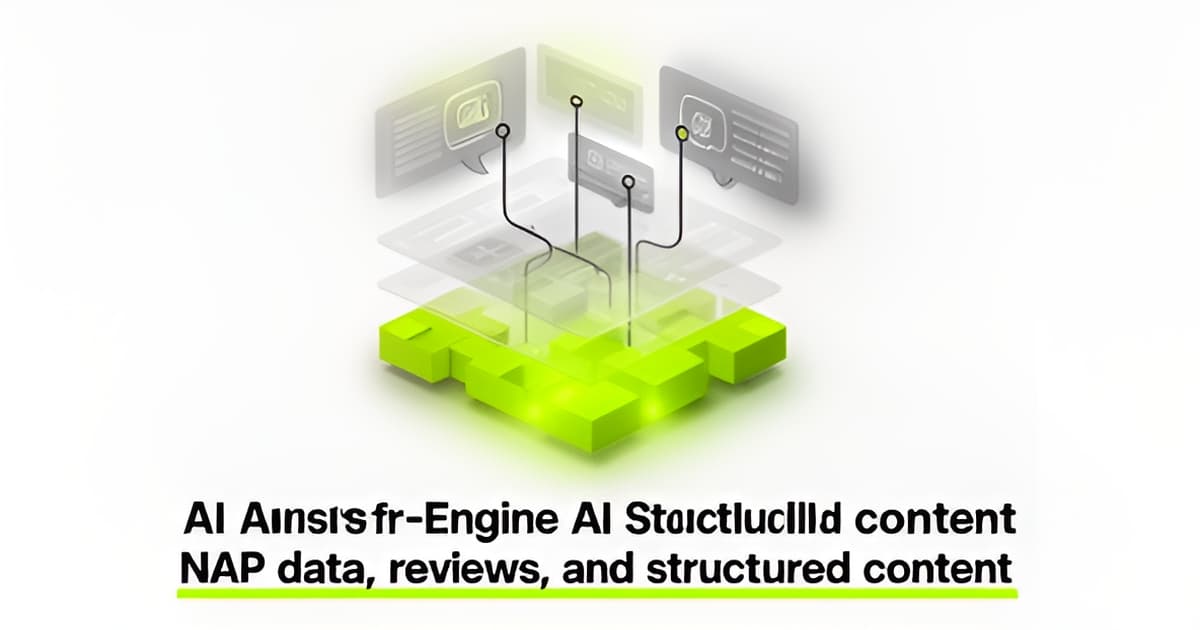
Industry consultants frequently reference what they call the 'evidence layer.' This concept describes the minimum set of reliable data that AI systems look for before deciding to cite a business. The layer consists of several interconnected components. First, NAP consistency, ensuring the business name, address, and phone number are identical across directories, the website, and social profiles. Second, review volume and quality; AI models are trained on vast amounts of text, and genuine, recent reviews serve as strong signals of a business's real-world operation and customer satisfaction. Third, authoritative content. This does not mean stuffing pages with keywords; rather, it means having well-structured pages that clearly define services, service areas, and business hours. Finally, technical accessibility. If a website is blocked from AI crawlers or has a structure that large language models cannot parse, even the best local SEO will fail to translate into AI visibility. For a trades business owner who may not understand technical SEO, this is often the most daunting part of the transition.
The demand for managed search-visibility services is driven by the reality that small business owners rarely have the time or technical inclination to manage complex dashboards, track citation changes, or optimize content for multiple large language models. A tradesperson, for example, is focused on completing jobs, not auditing their online citations. This is where the 'done-for-you' model comes in. By offering a month-to-month managed service, consultancies can handle the ongoing monitoring of local citations, the generation of optimized content, and the tracking of AI visibility trends. This arrangement allows the business owner to remain focused on their core trade while ensuring that their digital footprint remains consistent and optimized across the evolving search landscape. The model also addresses a common buyer pain point: the fear of long-term contracts with unproven technologies. A month-to-month structure provides a safety valve, allowing businesses to adjust their investment as the technology matures.
As the industry matures, a healthy skepticism has emerged toward companies promising guaranteed AI citations or fixed rankings in chatbots. No consultancy can control the internal algorithms of ChatGPT, Gemini, Claude, or Perplexity. Any claim to the contrary should be met with caution. The approach taken by forward-thinking consultancies is to frame results as directional. This means reporting on trends, whether a business is appearing more frequently in AI summaries over time, or whether its citation profile is improving, rather than promising a specific position. For the business owner, this transparency is valuable. It sets realistic expectations and focuses the partnership on building a stronger, more credible online presence, which benefits the business regardless of exactly where an AI model chooses to cite it. The goal is inclusion in the synthesis, not a fixed slot.
The rise of answer engines is not a reason to abandon traditional SEO, but rather an expansion of what that work entails. For small businesses, the path to visibility in AI Overviews and chatbot responses begins with the same fundamentals that have always mattered: accurate business data, genuine reviews, and clear, authoritative content. These elements form the evidence layer that AI systems rely on. While the technology may feel opaque, the underlying requirements are grounded in established best practices. For business owners looking to stay visible, the strategy is straightforward: strengthen the foundational signals, partner with a transparent service provider, and understand that visibility in the age of AI is a marathon, not a sprint.