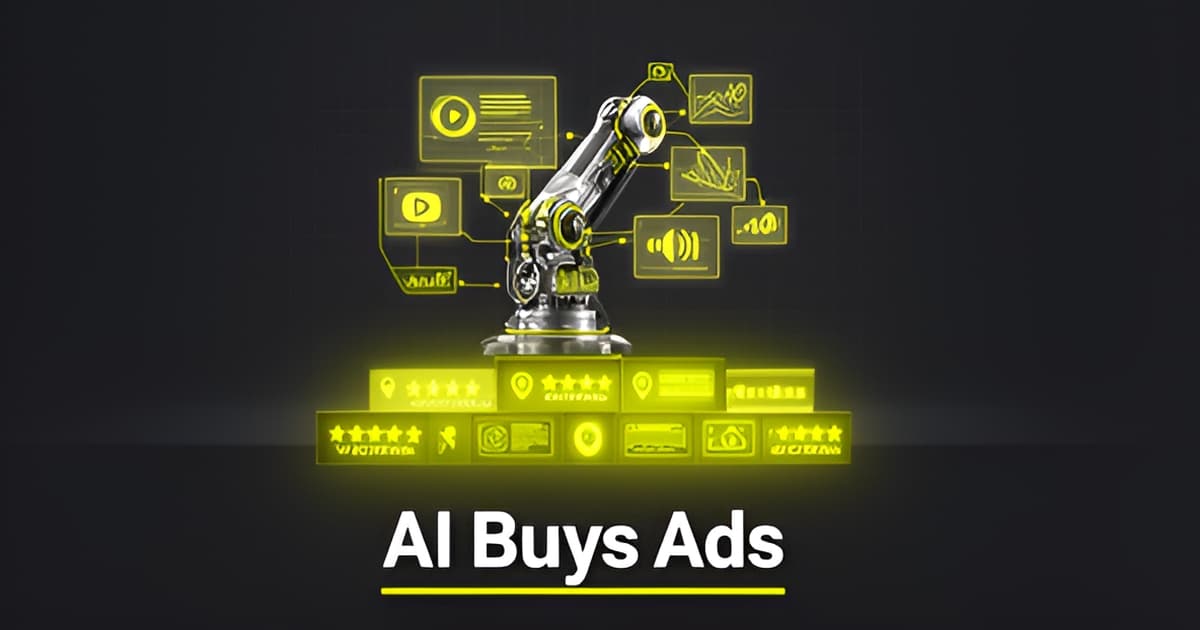
Amazon reported $201.9 billion in revenue for Q3 2026 on October 29, up 12% year over year, with a company-record 13.9% operating margin. Impressive numbers, sure. But buried in the earnings call was a quieter announcement that matters more to small business owners than any margin figure: Amazon now has an AI system that buys ads on your behalf. The tool is called Ads Agent, unveiled in September, and it spans sponsored ads, display, video, and audio. You set your objectives. The platform does the rest: it assembles campaigns, allocates budget, and optimizes placements. Combined with new Full-Funnel Campaigns and unified buying through DVA+, Amazon is collapsing what used to be a hands-on discipline into a natural-language conversation. At the same time, the company reported that Alexa shopping interactions jumped 570% year over year, with more than 400 million customers using Alexa for shopping in the past year. So on one side of the marketplace, an AI is buying the ads. On the other side, an AI is placing the orders. If you run a plumbing company, a law practice, or an HVAC business, you should pay attention to this. Not because you need to rush out and automate your ad buying, but because it confirms where discovery is heading, and it clarifies what you can and can't control about it.
Key points
- Amazon reported $19.64B in ad revenue for Q3 2026 and unveiled Ads Agent, an AI system that assembles and optimizes campaigns across sponsored, display, video, and audio formats after advertisers set their goals.
- Alexa shopping interactions grew 570% year over year, with more than 400 million customers using it in the past 12 months, signaling that conversational AI is becoming a primary discovery and purchase channel.
- Platform-reported performance claims, like the 67% higher long-term ROAS cited for Full-Funnel Campaigns, are company beta figures and partly rest on modeled sales, not independent verification.
- Agentic ad buying concentrates decision-making inside the platform that sells the media, which raises the value of owning your own data, content, and reporting.
- Small businesses can't control AI answer engines, but they can control the evidence layer: accurate business facts, local SEO, reviews, citations, and technical accessibility for AI crawlers.
Agentic ad buying is genuinely appealing. Most owner-operators don't have time to manage campaign structures, bid strategies, and audience splits across four ad formats. Handing that to a system that optimizes continuously sounds like a fair deal. Here's the trade-off, though. When the platform assembles and optimizes your campaigns after you state a goal, the decision-making moves inside the company that sells the media. You're trusting Amazon's AI to spend your money in Amazon's interest, and the two aren't always identical. Amazon cites beta results for its Full-Funnel Campaigns: 67% higher long-term ROAS and 29% lower new-to-brand acquisition costs. Those figures are company-reported, not independently verified, and they partly rest on modeled sales rather than tracked transactions. That last part deserves emphasis. When a platform measures its own performance using models it built, you should ask what was actually observed versus what was estimated. There's a broader point here that applies well beyond Amazon: a platform's revenue growth tells you nothing about your return on investment. Amazon's ad business brought in $19.64 billion this quarter. That's a fact about Amazon. Whether your roofing company got profitable customers from a $2,000 monthly spend is a separate question entirely, and it's the one that matters to you.
The Alexa numbers are the louder signal for local businesses. A 570% jump in shopping interactions, with 400 million-plus customers and order values reportedly 50% higher than average, points to a real shift in behavior. People are increasingly asking a conversational agent what to buy and who to hire instead of typing a query and scanning results. This mirrors what we're seeing across AI search generally. Google's AI Overviews, ChatGPT, Gemini, Claude, Perplexity, and Copilot all answer questions directly, and they increasingly recommend specific businesses when users ask for a plumber, an accountant, or a landscaper nearby. Here's the uncomfortable part: you can't control any of these systems. No consultant can guarantee you a citation in ChatGPT or a placement in an AI Overview, and anyone who promises that is selling something they can't deliver. What these systems do is synthesize answers from evidence they find and trust. Which means your leverage lies in the evidence.
When an AI agent recommends a business, it isn't pulling that recommendation from thin air. It's drawing on signals it can verify: your Google Business Profile accuracy, your review volume and recency, consistent citations across directories, structured content that clearly states what you do and where you do it, and a website that AI crawlers can actually access and parse. This is the evidence layer, and agentic AI raises its stakes rather than lowering them. Think about it from the machine's perspective. An AI shopping agent handling a customer's order, or an answer engine recommending a local service provider, has strong incentives to cite businesses whose facts are unambiguous. Vague, thin, or contradictory information gets skipped. Clear, consistent, well-sourced information gets reused. Amazon's own behavior backs this up. On the earnings call, management stressed that Bedrock customers' inputs and outputs aren't shared with model providers or used for base model training. That's a trust play, and it reflects the same dynamic: AI adoption runs on confidence in the underlying data. The same logic applies to how AI systems treat your business information. If your hours, service area, pricing signals, and reviews are consistent everywhere they look, you're easier to trust and easier to recommend. None of this is exotic. It's conventional local SEO discipline, extended to a new set of readers. Strong fundamentals, useful content, technical accessibility, reviews, citations, and authority. What's changed is who's reading.
There's a second lesson in Amazon's quarter, and it's about ownership. As platforms take over more of the buying and measuring, the risk isn't just opaque performance claims. It's that your historical campaign data, your audience relationships, and your performance records live inside someone else's system, formatted in ways only their tools can read. Amazon's $220 billion capital expenditure guidance for 2026, with further increases expected in 2027, tells you how aggressively the infrastructure layer is being consolidated. Management noted that roughly 85% of global IT spend remains on-premises and framed the migration as a 10-to-20-year cycle. Translation: this shift is early, and the businesses that build durable, self-owned assets now will compound advantages for years. For a small business, the self-owned assets are straightforward. Your website and domain. Your content. Your customer data. Your review history. Your first-party reporting on where you actually show up across Google and the major AI answer engines. When a platform offers to handle everything for you, the fair question is: at the end of the engagement, what do I own, and can I see exactly what was measured versus what was modeled? If the answer is vague, that's your answer.
You don't need to become an AI advertising expert. You need to make sure the foundation is in place so that both human searchers and AI systems can find and trust you. A practical starting checklist: First, audit your business facts. Is your Google Business Profile complete and current? Do your name, address, phone number, hours, and service descriptions match across your website and major directories? Inconsistency is the most common and most fixable visibility problem we see. Second, check whether AI systems can read your site. Many sites block or confuse AI crawlers without the owner knowing. If ChatGPT or Perplexity can't access your pages, you can't appear in their answers, no matter how good your content is. Third, get a baseline. Before you invest in any AI-driven ad product or visibility service, know where you stand today: which queries surface you on Google, which AI engines mention you, and which competitors dominate the answers in your service area. A directional visibility report gives you that baseline without hype. Fourth, if you do experiment with agentic ad tools, demand clarity on measurement. Ask what was tracked versus modeled, and keep your own records of spend and lead source. Convenience is fine. Opacity is not.
Amazon's quarter makes one thing plain: AI is moving from a tool you use to a middleman you work through, on both the advertising and the shopping side of the transaction. That shift is early, and it will unfold over years, which is good news. It means there's still time to build the foundation. You can't control what ChatGPT, Gemini, or Google's AI Overviews say. Nobody can, and you should be skeptical of anyone who claims otherwise. What you can control is whether the facts those systems find about your business are accurate, consistent, and easy to reuse. That's not a guarantee of visibility. It's the prerequisite for it, and it's the part of this transition that will still be yours when the platforms finish rearranging themselves.