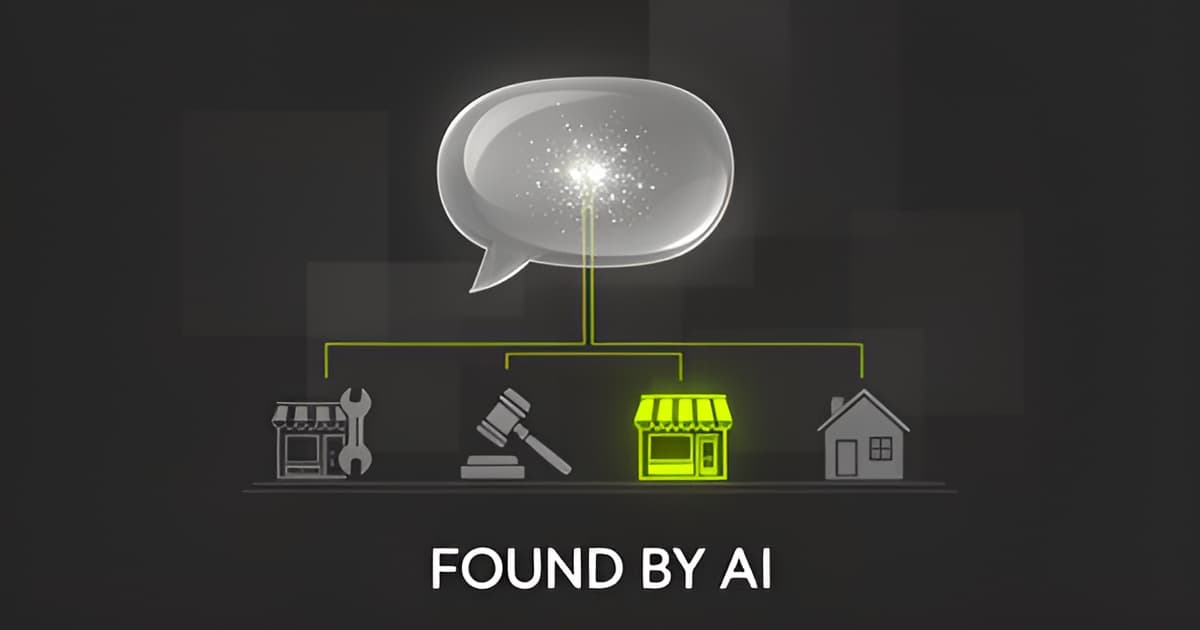
If you run a plumbing company, a law practice, or an HVAC business, you've probably noticed something odd over the past couple of years. People still search for you. But fewer of them seem to click through to your website. That's not your imagination. When someone types "24-hour plumber near me" into Google, they often get an AI-generated answer at the top of the page before they see a single blue link. When they ask ChatGPT or Perplexity for a recommendation, they get a short list of names, sometimes with a summary of why those businesses were chosen. If your company isn't in that answer, you may as well not exist for that customer. This shift has created a new discipline that goes by several names: AI SEO, generative engine optimization (GEO), answer engine optimization (AEO). The jargon varies. The underlying idea doesn't. Your business now needs to be discoverable and reusable by machines that summarize, not just by search engines that rank. The good news: the fundamentals that made you visible in Google still matter, probably more than ever. The confusing news: the way you apply them has changed, and a lot of vendors are selling solutions that overpromise. Here's a grounded look at what's happening and what a small business owner can realistically do about it.
Key points
- AI Overviews and answer engines increasingly answer local queries directly, which means visibility now matters as much as traffic
- AI systems reuse verifiable facts: consistent business information, genuine reviews, accessible websites, and authoritative content
- No vendor can guarantee placement in ChatGPT, Gemini, Perplexity, or Google AI Overviews, and anyone claiming otherwise should be avoided
- Small businesses in trades and professional services are falling behind enterprises that already have teams managing multi-engine visibility
- A free AI SEO visibility report is a practical first step to see where your business actually stands across Google and the major answer engines
For two decades, local search worked a certain way. A customer searched, scanned a page of results, and clicked. Ranking in the top few results was the whole game. AI has broken that pattern. Google's AI Overviews now frequently answer the question directly at the top of the results page. ChatGPT, Gemini, Claude, Perplexity, and Copilot handle a growing share of queries that used to go to a search box. In each case, the user may get what they need without visiting anyone's website. That changes what "visibility" means. A click to your site is still valuable. But being named, quoted, or cited inside an AI answer is now a separate outcome worth pursuing in its own right. If an AI assistant tells a homeowner your roofing company is a trusted local option, that mention can drive a phone call even if the person never sees your homepage. The practical implication is uncomfortable but simple: you can have decent Google rankings and still be invisible in the answer layer. These are two different systems reading the web in two different ways.
There's a persistent myth that getting cited by an AI is some kind of trick you can pull off with the right hack. In practice, the opposite is true. AI systems are built to reduce hallucination, which means they look for corroboration before they state a fact about your business. What does that corroboration look like? It's the same evidence a careful human researcher would want: your name, address, and phone number consistent across directories; a complete and accurate Google Business Profile; genuine customer reviews; service pages that clearly state what you do, where you do it, and what it costs or involves; structured data that machines can parse; and a website that AI crawlers can actually access. Think of it as an evidence layer. The AI doesn't invent your reputation. It assembles one from what it can find and cross-check. If your hours conflict across four directories, if your site blocks the crawlers these systems use, or if nobody authoritative mentions you anywhere, the AI has nothing reliable to work with. It will cite someone else. This is why AI SEO isn't a replacement for conventional SEO. Strong local SEO, useful content, technical accessibility, reviews, and citations form the foundation. AI systems discover and reuse that foundation. Skip it, and no amount of clever prompt-era tactics will fill the gap.
Another reason this gets complicated fast: the major answer engines don't behave identically. Google's AI Overviews draw heavily on Google's own index and local ecosystem, which makes your Business Profile and review profile unusually important. ChatGPT Search blends its own retrieval with live web results. Perplexity leans toward clearly sourced, well-structured pages it can cite directly. Each system has its own crawlers, its own retrieval habits, and its own tolerance for ambiguity. A strategy tuned only for Google leaves you exposed on the others, and vice versa. For a small business owner, that means the workload has multiplied. You're not managing one search engine anymore. You're managing a fragmented ecosystem of them, each with different technical requirements. This is where the market has shifted toward managed services. Most owners of trades and professional firms don't want to learn the difference between schema types or monitor whether an AI crawler got blocked last week. They want someone else to handle it, with reporting they can actually understand.
Here's the part of this story that deserves the most skepticism. No one, including the most sophisticated agency on the planet, can guarantee your business a citation in ChatGPT, a mention in Gemini, or placement in a Google AI Overview. These systems are controlled by their operators, they update constantly, and their selection processes aren't published. Yet the industry is full of vendors implying exactly that kind of control. If you hear "guaranteed AI citations" or "we'll get you into ChatGPT results," treat it the way you'd treat a roofing contractor promising a leak-free roof forever with no inspection. It's a claim no one can honestly make. What a competent partner can do is measurable and directional: make your business facts consistent and machine-readable, improve your technical accessibility to AI crawlers, strengthen your local signals and reviews, publish content worth citing, and track over time whether your visibility in AI answers is trending up or down. Results should be reported honestly, including when something isn't working yet. The month-to-month model matters here too. If a provider can't demonstrate value without locking you into a long contract, that tells you something. And you should always own your own website, content, domain, and data. If leaving a vendor means losing your web presence, you never really had one.
Large enterprises have marketing teams tracking all of this. Most small local businesses don't, and the gap is widening. A regional law firm or an independent restoration company is often competing in AI answers against national brands with dedicated content operations. That's a real disadvantage, but it's not a hopeless one. AI systems answering local queries strongly favor local relevance. A well-maintained Business Profile, a steady stream of genuine reviews, accurate citations, and clear service pages can beat a national brand's generic content when the question is "who's good near me?" The first step is knowing where you stand. A visibility report that shows how (and whether) AI systems currently describe your business, across Google and the major answer engines, tends to be eye-opening. Some businesses discover they're being described with wrong hours or wrong services. Some discover a competitor is being recommended in their territory. Either way, you can't fix what you haven't measured. Just keep expectations calibrated. A report is a snapshot, not a prophecy. Visibility in AI search builds gradually as your evidence layer strengthens, and it should be tracked as a trend, not judged from a single data point.
AI search hasn't made local SEO obsolete. It has made the fundamentals matter in a new way, because the machines answering your customers' questions rely on exactly the evidence good SEO creates: accurate facts, real reviews, accessible pages, and genuine authority. The businesses winning in 2026 aren't the ones chasing tricks. They're the ones whose information is clean, consistent, and easy for both people and AI systems to verify. If you haven't checked how AI engines currently describe your business, that's the place to start. And when you evaluate help, favor the partners who promise work you can verify over the ones promising results nobody can guarantee.