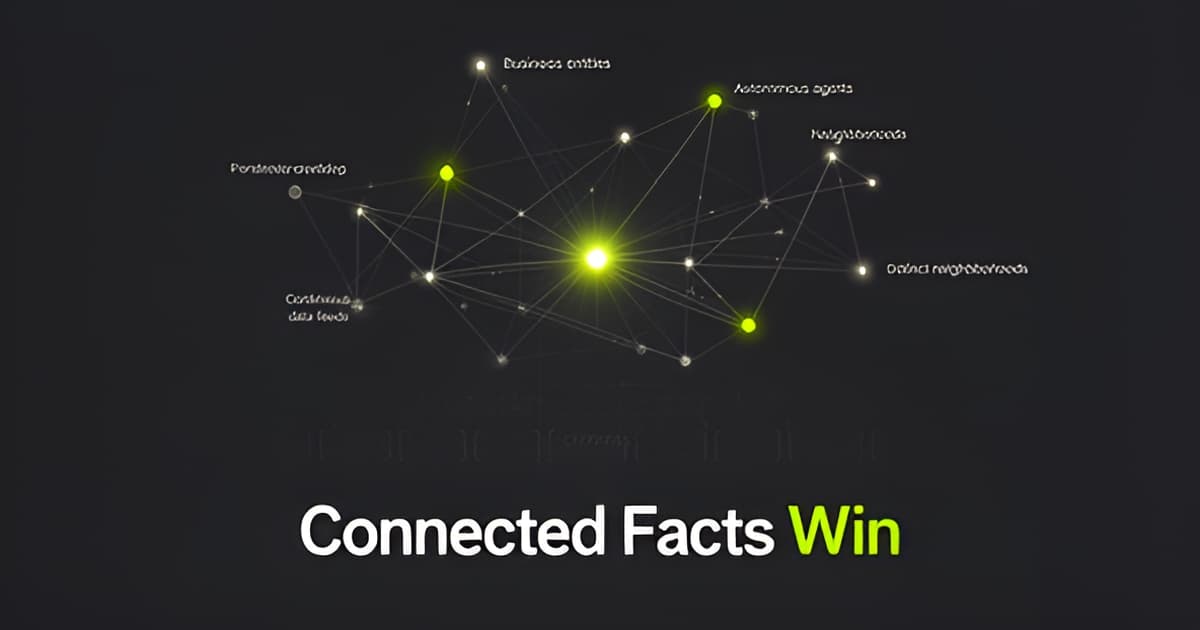
On October 23, 2026, a discount real estate brokerage from Covington, Louisiana made an announcement that deserves more attention than it will probably get. 1 Percent Lists, a franchise network that charges homeowners a 1% listing fee, said it's rolling out a nationwide knowledge graph: a structured, interconnected map of its offices, agents, listings, and market data, built specifically so that AI systems like ChatGPT, Gemini, Perplexity, and Google's AI Overviews can read and understand it. If you run an HVAC company, a law practice, or a dental clinic, you might assume this kind of project belongs to venture-funded proptech companies with data teams. It doesn't. And that's exactly why this story matters to you.
Key points
- 1 Percent Lists, a 1% listing-fee brokerage based in Covington, Louisiana, announced a nationwide AI-oriented knowledge graph built with agency One Click SEO.
- The system converts MLS feeds, agent credentials, and neighborhood data into machine-readable JSON-LD entities linked by relationships like worksFor and areaServed.
- The move signals that AI visibility is built on an evidence layer of structured data and entity consistency rather than tricks aimed at chatbots.
- Multi-location businesses face the same challenge: AI engines either see their locations as one coherent brand or miss them entirely.
- No vendor can guarantee AI citations; results from this rollout are unverified, and businesses should treat AI visibility as directional, measurable work over time.
The brokerage partnered with One Click SEO, a national search marketing agency founded by Dean Cacioppo, to deploy two proprietary tools: Schema MONKEE, which generates nested JSON-LD structured data, and Blog MONKEE, which handles content syndication and entity authority building. In practical terms, they took raw MLS feeds, transaction histories, and agent information and converted them into machine-readable entities. Hundreds of data points are now linked together using relationship identifiers like worksFor, areaServed, and creator. Instead of leaving each franchise office as an isolated website, the network now presents itself as one connected, verifiable entity that AI systems can parse and cross-check. CEO Grant Clayton framed it as a natural extension of the company's low-fee model: efficiency is what makes the 1% listing fee possible, and being cited directly in AI answers is, in his words, the new gold standard for visibility. Cacioppo described the goal as entity clarity: presenting the whole franchise as a single authoritative real estate entity rather than a scatter of disconnected local offices.
Here's the part worth sitting with. Generative AI engines don't evaluate content the way traditional crawlers did. A keyword crawler mostly asked: does this page contain the words the user searched for? An AI answer engine asks something closer to: is this a credible, verifiable source about this specific thing, and can I connect it to other credible facts? That second question is answered with structure. Schema markup, consistent business facts, clear entity relationships, citations, and reviews form an evidence layer that AI systems discover and reuse when they compose answers. You can't force ChatGPT to cite you. You can make it dramatically easier for ChatGPT to understand who you are, what you do, and where you do it. That's the real lesson of this story. A mid-market franchise, without venture money or an in-house data science team, achieved entity-level sophistication using tools and techniques that are available to businesses a fraction of its size.
If you operate more than one location, or even one location with multiple service lines, you have a version of the same problem 1 Percent Lists solved. AI engines either see your business as one coherent brand, or they see fragments: a Google Business Profile here, a website there, a handful of citations with slightly different names and phone numbers, and no clear connection between any of it. Fragments don't get cited. Coherent entities do. For a plumber with three trucks and a warehouse, coherence means the same business name, address, and phone number everywhere; service-area markup on the website; consistent descriptions of what you do; and content that establishes you as the entity behind that work. For a law firm with two offices and six practice areas, it means practice-area pages that clearly connect to the firm entity, attorney profiles with proper credentials markup, and location pages that don't contradict each other. None of this requires a knowledge graph with hundreds of nodes. It requires the same principle applied at your scale: connect the facts about your business so a machine reading them sees one business, not several.
One thing the 1 Percent Lists announcement gets right, and that some vendors get wrong, is the framing. The agency describes this work as Generative Engine Optimization, or GEO. That label is useful, but it can mislead buyers into thinking it's a replacement for conventional SEO. It isn't. Structured data, entity consistency, local citations, useful content, and technical accessibility are the foundation for both. AI visibility sits on top of strong local SEO fundamentals, and a business with weak reviews, thin content, or inconsistent listings won't get cited by AI systems no matter how much schema markup it deploys. The knowledge graph works because the underlying facts are real, consistent, and verifiable. So if someone pitches you AI search optimization while ignoring your Google Business Profile, your reviews, or your citation accuracy, treat that as a warning sign.
It's worth being direct about one thing: this is a press release from a vendor and its client. The announcement includes claims that AI engines will validate the brokerage's sources and position its agents as authoritative recommendations. Those are aspirations, not outcomes. No third-party citation data or performance metrics were published, and nobody, including the agency that built this, can guarantee inclusion in any AI answer. That doesn't make the project a bad idea. The architecture is sound and the direction of travel is right. But if you're evaluating any AI visibility vendor, ask for baseline measurements and directional tracking over time, not promises. Where do you currently appear in AI Overviews and chatbot answers for your core services? What's your entity consistency across Google, Maps, and the major citation sources? Can they show movement, even if they can't show guarantees?
The 1 Percent Lists rollout is a useful signal for anyone who owns a local business: the gap between companies AI engines understand and companies they ignore is widening, and it's being closed with structured data and clear entity facts rather than budgets. You don't need a franchise network or a proptech platform to compete. You need your business facts to be accurate, connected, and visible where AI systems look for evidence. Start by finding out where you stand. A directional AI visibility report will tell you which of your facts AI engines can currently find, which ones contradict each other, and what to fix first.